

|
|

Page 2 of 2:
Make a hole with a shovel for placing the tree in the soil of the wooden box. The hole should be quite a bit larger than the rootball. The tree is placed in the centre, with the help of another person, if necessary, to hold it. If the tree is too large and, due to the shape of the rootball, it appears that it is not going to remain very firm, it is advisable before closing the hole to put in a strong stick to which the tree can subsequently be fastened.
The soil is
usually placed over the hole. It should never be tamped down,
since that would hinder the subsequent supplying of air and, also,
would break some of the fine roots. Next, the rootball has to
be 'muddied'.
This means that it must be watered with special intensity so that
the soil is distributed well among the roots, securing the tree
in its position. Now you can proceed to water the tree, adding
a growth hormone such as vitamin B2 or Super Thrive to the water.
Some authors (Peter Adams for example) explain that, before planting
the rootball, they leave it an entire night in a receptacle of
water to which a growth hormone has been added. Nothing will happen
if, in the beginning, the level of the soil is higher around the
trunk than in the rest of the box. Over the time, it will level
off.
If the wooden box is in full sunlight, the crown can be covered with a shade netting that can be found in various densities in specialised gardening shops. This netting prevents drying since it will reflect more than 50% of the sun's rays. In addition, this mesh will permit the creation of a moist microclimate that will be beneficial to the tree during the first weeks. It can also be sprayed with anti-evaporation protection as is done in greenhouses when valuable conifers are transplanted. Anti-evaporation protection is a solution that is mixed with water and applied to the needles with a sprayer. This substance creates a fine layer of wax that is not impenetrable, but that reduces evaporation notably, depending on the concentration. The film is rain-resistant, but disappears by itself after a few weeks.
As has been
said, the container can be a wooden box, but also a large plastic
tub, a plastic washbowl, or an extra large bonsai pot if you have
one available (which would be unusual). Logically, all these receptacles
must have one or, much more advisable, several holes for drainage.
Some professionals insist that it is essential to have the soil
sterilised.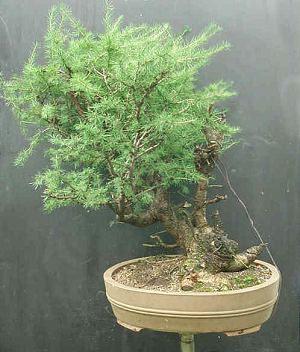
The rootball does not have to be cut to the measurements of the container, a container must be found in which the rootball will fit. It is preferable to have the tree fit exactly in the container. It is not good if the container is too large because too much moisture will accumulate in the soil that could cause the roots to rot. The container must be strong enough to support the weight of the tree, generally large and heavy trees, together with the soil. It must also be kept in mind that almost certainly in the coming months the whole thing will have to be moved, so very large trees it is advisable for the container to have handles.
As has been
said, the mix that you use now will be more permeable than the
soil that will be use subsequently as bonsai soil.
Good results have been obtained with a mixture of 40% coarse sand,
30% akadama and 30% composted bark humus. Pumice stone has proved
to be very efficacious as soil for the bottom of very large receptacles.
It has characteristics similar to those of akadama or lava granules,
but it is lighter. Many enthusiasts avoid using old soil for fear
of bacteria and the remains of fertiliser. However, it is advisable
to add soil from healthy trees in order to include mycorrhiza.
Immediately after planting the tree, the soil has to be watered thoroughly. Afterwards it only has to be kept relatively moist so that the roots will be stimulated to grow. On the contrary, the crown has to be sprayed with water daily to keep it always moist. In no case should fertiliser be applied before the tree shows clear signs of growing.
The container
should be placed in a shady location, if possible, away from currents
of air. Here it must stay until the tree shows clear signs that
it has caught on.
Then it should be placed in semi-shade and, subsequently, in sunlight.
It is important to protect the tree right after collecting from
frosts or desiccating winds.
To do that, the ideal is to keep it in a cold greenhouse for the
first year. For very valuable trees, a heating system may even
be installed in the floor, a system that you can find in shops
specialising in accessories for greenhouses. It appears that in
Japan they even install small nozzles in the floor, under the
roots, that regularly blow warm vapour on the cold roots.
Serge Clemence
has developed a method with which he has succeeded in getting
even trees with poor roots to catch on well. He carries a rucksack
full of sphagnum moss to the spot where he found the tree. Immediately
after digging it up, he wraps the rootball with the moss and ties
it.
Once he arrives home, he places the tree in a receptacle just
as it is and adds soil around it. He says the success is astonishing.
After a growing period, the moss is full of fine roots. Even trees
with fibrous roots collected from cracks in rocks, have caught
on this way. With this method it would also be possible to plant
trees in soil outside. Nick Lenz has developed a method for making
a larch layer easily with sphagnum moss. He discovered that the
layering only worked well with live sphagnum moss and thinks that
it is due to some hormone. Logically, this fact would be a great
endorsement for Serge Clemence's method.
Wait at least one growing period before starting to shape the
tree. It is important to make clear that you are talking about
growing periods and not months. If you collect a tree in Autumn
and plant it immediately in a wooden box, it may catch on that
Autumn, but you have to wait until it has definitely caught on
in the next Spring or Summer before starting any preparations
for shaping.
If a tree was dug up in Spring, possibly the first shaping tasks
can start in Autumn if it has enjoyed a Summer 'crowned with successes'.
The Number of Growing Periods from Collected Tree to Bonsai
Old Conifer |
Young Conifer |
Old
Deciduous Tree |
Young Deciduous Tree |
|||||
| Roots | Good |
Poor |
Good |
Poor |
Good |
Poor |
Good |
Poor |
| Preparation | 0-2 |
2-4 |
0-1 |
1-2 |
0-2 |
2-3 |
0 |
1 |
Large Box |
2-3 |
2-5 |
1-2 |
2-3 |
2-3 |
2-5 |
0 |
1 |
| Nursery Container | 1-2 |
2-3 |
1 |
1-2 |
1-2 |
2 |
1 |
1 |
| Start of Shaping | 3-7 |
6-12 |
2-4 |
4-7 |
3-7 |
6-7 |
1 |
3 |
| Shaping | 5-10 |
5-10 |
3-5 |
3-5 |
5-7 |
5-7 |
3-4 |
3-4 |
| Bonsai | 8-17 |
11-22 |
5-9 |
7-12 |
8-14 |
11-14 |
4-5 |
6-7 |
This table shows the timetable for a collected tree to be converted to a bonsai.
For example, for an old conifer (more than 50 years old) with a good rootball, between 3 and 7 growing periods may be necessary before being able to start shaping, while shaping itself may take between 5 and 10 periods. From the time a tree is found until the day when it can be called a bonsai, between 8 and 17 periods or, indeed, years pass. If the roots were not in an ideal condition from the beginning, the complete process may even take 11 to 22 growing periods. It is clear that shaping continues over many years.
<<Back to Collecting Trees From The Wild: Part Three, Page 1 of 2
<<Part Two